

Enterography With Contrast
MRI
Enterography With Contrast
₹21,000
About This Test
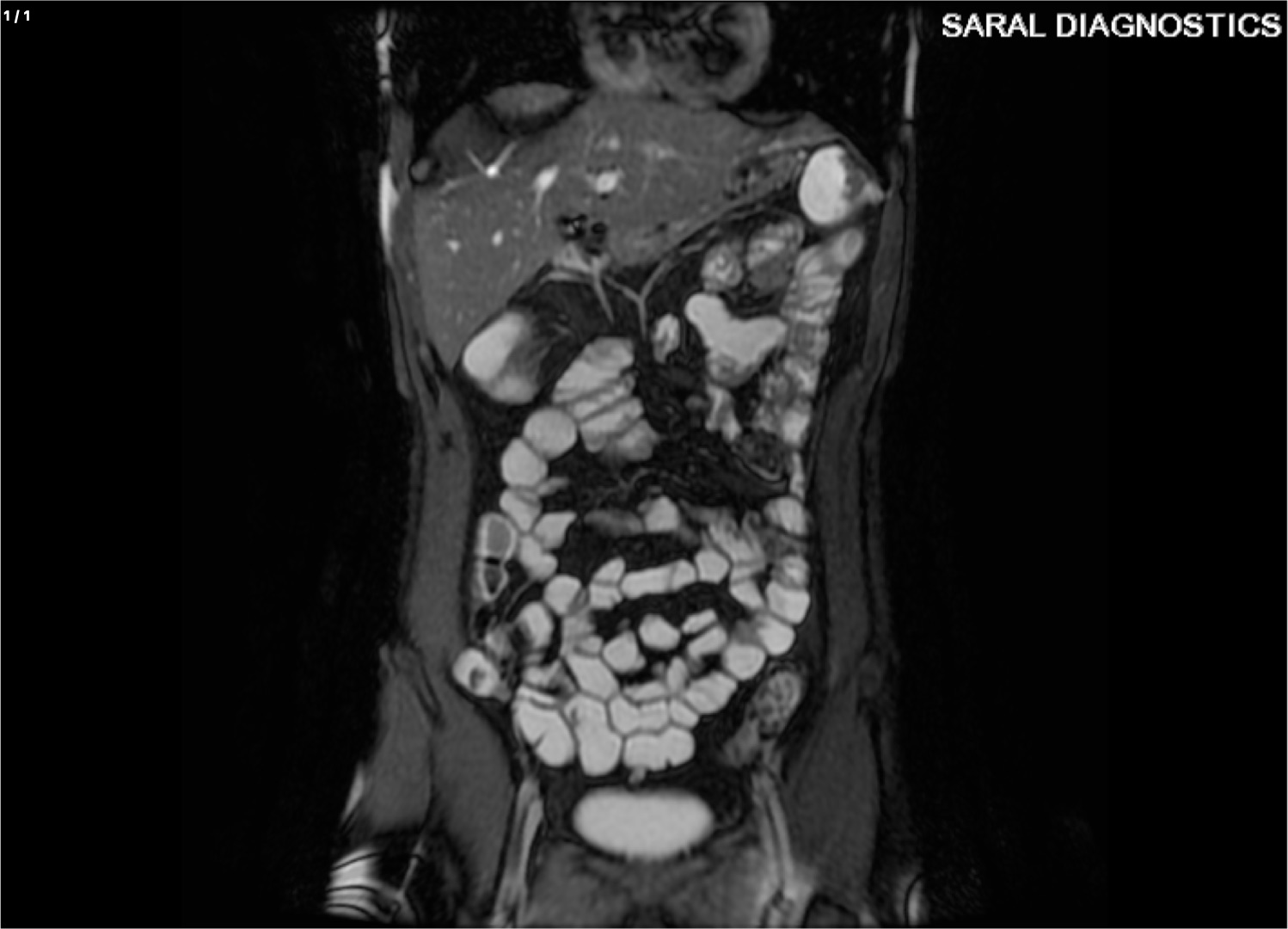
MRI Enterography is a special type of MRI scan for small intestine and other parts of the digestive system. It’s often used to check for conditions like Crohn’s disease, inflammation, tumors, or blockages in the intestines. The procedure is non-invasive, meaning it doesn’t require surgery or any cutting. MRI Enterography is helpful for diagnosing and monitoring digestive problems that cause symptoms like stomach pain, bloating, diarrhea, or weight loss.
The procedure involves drinking an oral contrast agent to distend the bowel and taking medication to slow bowel movement. The MRI uses magnets and radio waves to create detailed pictures of the inside of your abdomen. The contrast makes certain areas stand out more clearly, allowing doctors to spot problems like inflammation, infections, or tumors.
At a Glance
Home Collection
Not Available
Report TAT
1 Day
Category
MRI
Preparation / Prerequisite
- Light meal, avoid cold drinks & juice on previous day including early light dinner.
- Tablet Charcoal (4 tabs adltus & 2 tabs for child), Tablet Dulcolax (2 tabs.) to be taken previous night after dinner with water.
- To report Next full working day empty stomach.
- Once you reach centre , you will be asked to drink manitol 150ml diluted in 1.5 lit of water over a period of approx. 40 min . MRI scan will be subsequently performed in the next few minutes .
- Pace makers, Aeurysmal clips, insulin pumps & recent magnetic implants are contra indications.
- Pl remove jewellery at home for safety purpose. Remove eye make up before coming.
- If you have MRI incompatible pacemakers - MRI is not advised & is contraindicated. With MRI compatible pacemakers MRI is possible with support of yr pacemaker company engineer. Pl talk to yr pacemaker company engineer to organise with our FDO & techie team to fix appointment for MRI to make suitable changes in pacemaker mode at time of MRI.
- If patient has CT scan & contrast MRI both - do CT scan before contrast MRI as Gadolinium (MRI contrast) can affect quality of plain CT especially in abdomen.
- appointment desirable
- If there is MRI brain & EEG – try to do MRI brain before EEG. If do EEG before MRI brain – then clean the paste well , otherwise it can lead to artefacts during MRI.
- biopsy of any given part to be done after MRI study.
- Gap between MR lymphangiography and lymphoscintigraphy should be more than 4 to 5 days.
- MRCP to be done before starting oral for CT abdomen.
- Holter monitoring to be done after completing MRI study.
- Bring old records- text reports, films, CD.
- Today, most ortho implants, pacemakers etc are MRI compatible. If MRI compatible then we can do MRI even on next day of surgery. However pl confirm from your doctor about MRI compatibility in writing.
- Coronary stents & sternal sutures ( in cardiac bye pass) are not a contra indication for MRI.
For Pregnant patient -
Bring Photocopy of doctor precription & photo ID proof (adhar card, Voter ID or driving licence) for PNDT requirements (for Delhi center only) .
For Sedation –
Required for un coopertive patients like children etc. If patient has severe cough & cold / nasal blockage, fever, kidney or liver disease, low haemoglobin - avoid any kind of sedation. There are two types of sedation - oral & IV sedation. - Oral sedation – Usually works well for children < 2 yrs. Keep child fasting, bring his favourite food, remove metal from his body surface & clothes. We give oral sedative followed by meal after consultation with anasthetist, child likely to go to sleep.
- For IV sedation - fasting is required for 5-6 hours for IV sedation in consultation with yr doctor & our techie / anasthetist team.
- For Contrast studies –
- Kidney function should be normal. Under certain circumstances like age more than 60 yrs, known case of kidney disease, long standing diabetic or hypertensive. . Please bring your record of recent ( no more than 4 week old) Serum creatinine/eGFR report if already done. Else it may be done at Saral. After contrast study increase liquid intake for 24hrs after talking to your doctor.
if patient is lactating mother then feeding should be stopped for 24hrs. Can store milk if indicated.
If patient is pregnant then contrast study should be avoided , especially in first 3 months.
In contrast study post procedure instruction to drink more fluids after consultation with dr
Reference Image
Frequently Asked Questions
1. What is MRI scan?
ANS: It uses magnets and radio waves to create detailed body images.
2.What are pre-requisites?
ANS: Empty Stomach (Do not eat or drink for 4–6 hours before the exam).
You will be asked to drink a special oral contrast solution before the scan to help expand the small bowel.
Avoid Diary product 24 hrs before scan.
Bring old records.
You will be asked to drink a special oral contrast solution before the scan to help expand the small bowel.
Avoid Diary product 24 hrs before scan.
Bring old records.
3. What is MRI Enterography With Contrast ?
ANS: MRI exam that produces detailed images of the small intestine and surrounding abdominal structures using magnetic fields and radio waves. It is commonly used to evaluate bowel inflammation and disease without radiation.
to assess:
- Crohn’s disease and other inflammatory bowel diseases (IBD)
- Small bowel inflammation or strictures
- Fistulas or abscesses
- Bowel obstruction
- Unexplained abdominal pain or diarrhea
to assess:
- Crohn’s disease and other inflammatory bowel diseases (IBD)
- Small bowel inflammation or strictures
- Fistulas or abscesses
- Bowel obstruction
- Unexplained abdominal pain or diarrhea
4. If contrast study ?
ANS : latest eGFR / creatinine report (within 1 month) is required.
5. Is MRI safe?
ANS: Yes. MRI does not use radiation. It is generally very safe. However, patients with certain metal implants or devices may not be eligible.
6. How long does it take?
ANS : 50–60 minutes depending on the area.
7. What if I am claustrophobic?
ANS: Inform the staff beforehand. Options include: Mild sedation.
8. Is an any attandend required ?
ANS : Yes, attendend is required for any invasive procedure or IV sedation.
9. Is the machine noisy?
ANS: Yes, but ear protection is provided.
10. Do I need to lie completely still?
ANS: Yes, to get clear images.
11. If a pacemaker is implanted, can MRI done?
ANS: If you have a pacemaker, this test may or may not be possible. Some modern pacemakers are MRI-compatible (MRI-conditional), while older ones are not. Always inform the doctor and MRI staff about your pacemaker before the scan.
12. Is an appointment required for MRI or not?
ANS : Appointment is preferably else you will rare to wait for your turn.
TAT Policy
The Turnaround Time (TAT) depends on the following factors:
- Registration date and time
- Type of scan or test
- Scan time or sample collection time
In uncommon circumstances, TAT may be delayed due to test complexity or reasons beyond our control. You will be informed of the estimated TAT at the time of registration.